Alone in a Foreign Land: Part Adventure, Part Challenge

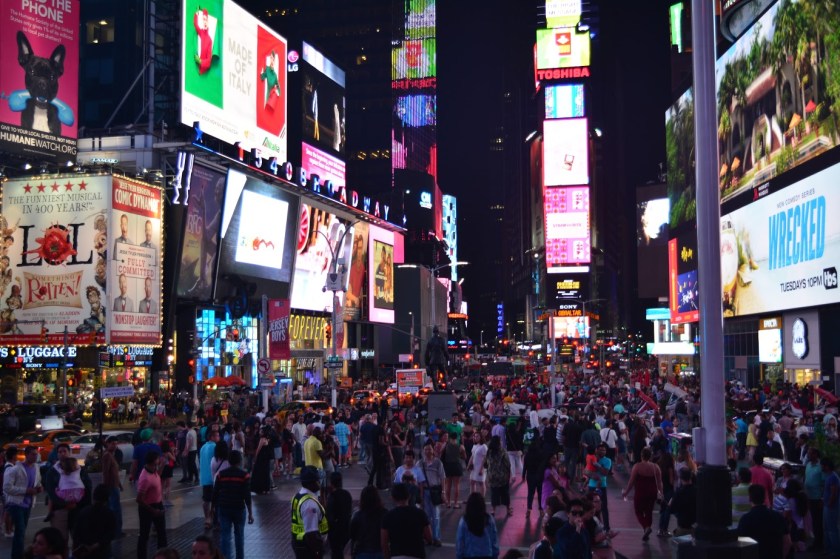
times sq

I have been living away from home for a long time now – it’s almost a decade since I moved out for the very first time, as a naive sheltered 17-year-old girl. Nearly five of those years have been spent in New York City. That’s half a world away from India, away from where I grew up, away from all the people I love the most. I have had to build my support system from the ground up, while also learning to navigate the streets, conduct research in a new lab, and understand the culture of a foreign city. It’s been quite the ride, and I have lived and experienced every moment to the fullest – the highs and the lows, the twists and turns, the victories and delights, and all the bumps and bruises. And while I have many, many thoughts on how my life has turned out based on all the choices I have made so far, it’s hard to sum up what this phase of my life has meant to me. What does living all alone in a foreign country entail? Is it the best of times, or the worst of times? Is it a glamorous adventure, or the toughest of challenges?

The best part of living abroad by yourself? Most definitely the independence. The freedom of living life on your own terms, and exploring the streets of a strange and exciting city. The sheer independence of not having anyone to care about what you wear, where you go, or what time you get back home. The ability to test your own limits and set your own curfews. The liberty to spend your money on whatever you deem necessary, be it Seamless deliveries at midnight, or a cute mermaid tail blanket just because you saw it and now cannot live without it.

Living abroad by yourself is when you can immerse yourself in a whole new culture. It’s fascinating to observe how fast people walk, the left-right escalator etiquette, the public transport system. And if you live in NYC, every now and then you’ll come across a new location which seems strangely familiar – before you realize, oh right, countless movies and TV shows have been shot here. Oh, these are the steps in Central Park where Blair and Chuck from Gossip Girl got hastily married. This is the Roosevelt Island tram which White Collar’s gorgeous Neal Caffrey climbed up to escape capture. You can scout out all the famous locations, but you can also hunt down tiny little bookstores, in alleyways you wouldn’t wander down in the dark, and find new hidden cafes with nondescript doors and wonderfully eclectic interiors. Everything is ready and waiting to be discovered – like being in a real-life choose-your-own-adventure book with multiple chapters and endings just waiting to be explored.

Living abroad on your own also leads to self-exploration. You end up surrounded by a completely new culture, and you get to decide if you want to hold on fast to your own culture, adopt the new one, or find your own unique blend of old and new – your own set of beliefs and rules, and use them to fine-tune your moral compass. Living abroad is the time when you can figure out who you truly are, far away from all the expectations and societal pressures – getting some distance is what allows you to recognize those, and realize how much you’ve unquestioningly internalized. You can now question what you’ve never questioned, behave in a way you’d never have imagined, figure out the person you truly are – underneath all the people-pleasing, expectations-fulfilling, rule-following persona you’ve developed over time naturally and unthinkingly because that’s just the way it was. Living abroad allows you to remove all those masks and uncover how unconscious your core beliefs and biases are. It helps you grow into an authentic, messy, real version of yourself – and forces self-discovery like nothing else. Living abroad is an exciting, thrilling, and fascinating experience – I highly recommend it!


What’s the worst part of living abroad by yourself? Once again, the independence. The anonymity of being all alone in the crowd, and not having anyone who cares about what you wear, where you go, and what time you get back. There’s nobody who would automatically check in on you. It’s surprisingly easy to become isolated. You’re all by yourself in a completely new place, and every step is a new challenge – from finding the nearest grocery store and navigating unfamiliar social situations, to filing for taxes, and getting your social security number. Coming home at the end of the day can feel dreary, because you’re welcomed only by your (most likely, unmade) bed, and perhaps a plant or two. There’s no warm food on the table, no warm companion to ask how your day was. There’s no automatic social interaction after coming home, unless you specifically make plans with friends. You’re completely by yourself, and while that sense of freedom is liberating, it can also get lonely.

Also, the whole process of figuring out who you really are and testing your limits and beliefs is not easy. It’s unnerving to question what you’ve always held true. The transition period while you’re coming to terms with loosening your grip on the old belief system, and building a new one? It’s uncomfortable. It’s disturbing, because all of a sudden, ideas are fluid instead of rigid – and if you can’t rely on what you’ve held onto for twenty-something years, what’s the guarantee that this new system will serve you? All the absolutes start dissolving into relatives, there is no perfect right or wrong anymore. While building your own system from the ground up is essential for personal growth and self-awareness, the process can be rather bewildering . Change is good, but change is also hard, and while adventures are really exciting, they are by nature quite terrifying as well.


Knowing what I know now, would I do it again? Would I head out on a whole new adventure, or would I prefer stability and familiarity? Will I spread out my wings and fly out to a whole new phase of my life, or will I hang up my boots, and say, enough flying, I’m done – I know who I am now, and am happy with it, so now, after having accumulated all that experience and knowledge – watch me put down my roots now?

I’ve thought about it long and hard, and my conclusion is: while the idea of safe familiarity is tempting, so very tempting at times – I am an adventurer at heart. I’m always looking for the next challenge, the next hurdle, the next battle. I am not the kind of person who would be happy to settle for just good enough – I always want to be better, do better, strive for more. That path isn’t always easy, but it’s the path I choose. It’s the path I want. The bumpy one, with the crazy ups and downs. Because while the lows can be devastating indeed, the highs are just so incredibly rewarding. The harder the battle, the sweeter the victory. So bring on the next adventure. And watch me fly!

Reason #713 why I love New York: The Strand

I want books piled on my coffee tables, I want window sills stacked high with stray books. Books lining my staircases, books forgotten behind cushions and fleece throws in cozy armchairs. Books snoozing under my pillow, tottering on nightstands,  balancing on the edge of the tub. I want to live in my own little oasis of books, a little world in which my kids can grow up surrounded by witches and wizards, dragons and Shardbearers, boarding schools and midnight feasts, one-legged pirates and snarky Greek demigods. It’s a vividly colorful world, this second world I inhabit, and is a world I will welcome all my descendants into. 

All bookstores are magical treasure troves, but the Strand is pretty much my version of Aladdin’s Cave of Wonders.

strand
Behold, tons of stories just waiting to be read!

At the corner of 12th and Broadway, the Strand has a gigantic collection of rare books, classics with their quintessential leather-bound covers – so solid and indulgent, like books who mean business, alphabetized tall and narrow little stacks you can lose yourself in, all organized by genre and alphabet, an entire collection of cleverly-named candles, witty magnets, mugs, bookmarks, gorgeous journals and totes, humorous socks and other Strand paraphernalia, a banned books section, and a whole row of staff recommendations with detailed notes about how and why this book demands to be read this very minute – and while all those features make the Strand a terrific bookstore, what puts it over the top is the racks and racks of discounted second-hand books lined outside. Starting from as low as 48 cents, these books are wonderfully haphazard and disorganized – and it’s especially thrilling because you never know what you might stumble across. Old copies of Pride and Prejudice crammed against The Hitchhiker’s Guide to the Galaxy, mixed in with German folk tales, stodgily standing next to the rules of Hindi grammar, lined up with parenting help books, just adjacent to the single girl’s guide to NYC. I’ve found old yellowed books with notes inscribed in the margins (literary, as opposed to vandalism – there’s a fine line),  as well as books fresh and heady with that gorgeous new-book smell. The sheer variety delights my heart!

I’ve always felt more at peace with books as opposed to people. Those who saw me growing up can attest to the fact that whenever they came to visit, I’ve always had my nose buried in a book, and will only remove it with the greatest reluctance. I like to think I’ve changed a bit over time, become more of a people person, but maybe it’s just that I compartmentalize better now. Growing up, I’d collect books at stores and book fairs, I’d stack them, organize them by genre, author, frequency of re-reads, and caress them lovingly, read them over and over, trying to keep the pages un-creased and the spine intact (what kind of monster ruins book spines?! Or folds down pages?!). My books should remain as new as they were on the day I bought them.

At some point I realized that I don’t just like books, I need them. What started off as an indulgence has morphed into a necessity, and now I need extra ‘hits’ when I’ve had a bad day. While ‘going to the bookstore’ has always been the norm for when I wanted to celebrate some accomplishment (e.g. finished my annual exams and survived!) right from a young age, and getting books as gifts would make me happy in a way new clothes never did – I eventually figured out that a trip to the bookstore would also cheer me up immensely when I’ve had a hard day. Tired, stressed, lost, heartbroken – all these states of mind have been soothed over the years by a mere couple of hours in a bookstore. I feel at peace – like all the internal and external turmoil is held at bay by the hard covers (or paperbacks) of books. I’d go to a bookstore, pick up a novel, and curl up in a comfy armchair, surrounded by books and bookworms, and the quiet rustle of turning pages – it’s like a warm cocoon that wraps me up cozy and tight, a silvery force field of sorts, deflecting the world and all its troubles away from me. It’s my safe space, and nothing can hurt me while I’m there.

Books are something I take for granted, but whenever I stop and really think about it, I feel incredibly grateful to all the authors around the globe who pick up their pens and pick out the best words to share their stories, based in reality or imagination or both. I’m grateful to my parents for loving books themselves, and encouraging me to read more, explore more, as much as my heart desired. Reading is such an integral part of my identity that it’s hard to imagine a parallel universe in which I didn’t care to read. That universe seems colder, harsher, bleaker. My life is so much brighter, because I can choose to live multiple lives, think from varying perspectives, empathize better, and dream more resplendent dreams, all because of all the stories I get to read.

While e-books have revolutionized the ease of reading, I am determined to have a gigantic collection of physical books you can touch, see and smell (oh, that smell! Did you know that the Strand actually sells scented candles called Aged Page, and Cafe Au Library?). My dream house has a giant room full of books – wall-to-wall, floor-to-ceiling, many lifetimes worth of books. But apart from my very own personal library, I’d love to have books spilling over in other areas of my life, quite literally. I want books piled on my coffee tables, I want window sills stacked high with stray books. Books lining my staircases, books forgotten behind cushions and fleece throws in cozy armchairs. Books snoozing under my pillow, tottering on nightstands,  balancing on the edge of the tub. I want to live in my own little oasis of books, a little world in which my kids can grow up surrounded by witches and wizards, dragons and Shardbearers, boarding schools and midnight feasts, one-legged pirates and snarky Greek demigods. It’s a vividly colorful world, this second world I inhabit, and is a world I will welcome all my descendants into.

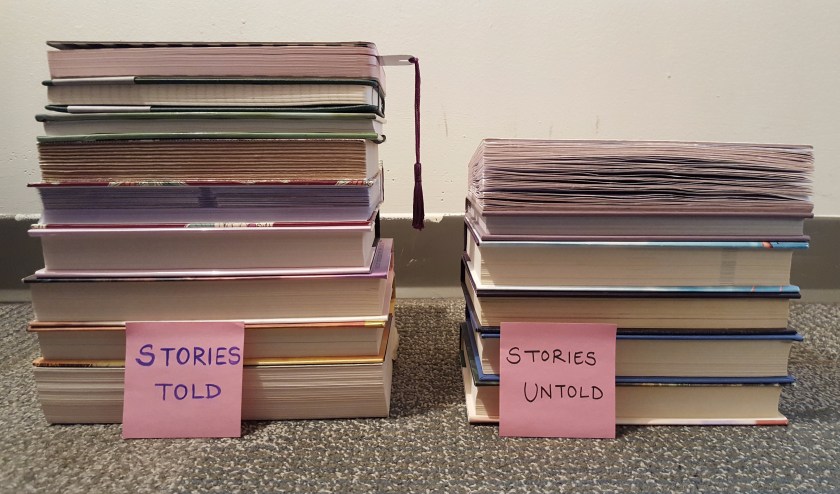
In Defense of Stories Untold

But ever so often, consciously or otherwise, we curate and edit our stories – and even if we call ourselves an open book, there are certain chapters we don’t read out loud, certain stories we don’t exchange while sitting around bonfires on beaches at night – because they don’t have conventionally acceptable happy endings, or because they paint us in an unflattering light, instead of as the valiant and righteous protagonists we’d like to be.

20171119_150008.jpg

We are all storytellers. We express ourselves through Instagram pictures, overly long Facebook posts, public blogs, or even just dramatic retellings at extra long lunch breaks with our friends. We love being narrators, in varying degrees of spotlight, and there’s something incredibly gratifying to have our audience connect with our narratives.

But ever so often, consciously or otherwise, we curate and edit our stories – and even if we call ourselves an open book, there are certain chapters we don’t read out loud, certain stories we don’t exchange while sitting around bonfires on beaches at night – because they don’t have conventionally acceptable happy endings, or because they paint us in an unflattering light, instead of as the valiant and righteous protagonists we’d like to be. So we bury these stories deep, never to see the light of day – and if we do decide to share them, we prefer to add filters to our photos, don masks for our one-man shows, and narrate our stories from a different angle. Maybe we’re afraid of being judged too harshly. Maybe the statute of limitations isn’t up yet. Maybe we are still in denial, and haven’t yet accepted this chapter. Maybe we look back and wonder what we were thinking in the first place, or if we were thinking at all. And so these stories, these untold stories, are kept under wraps because they spoil the overall narrative, you see? They don’t fit the image we’ve worked so hard to project. These stories are the chips in our armor, the unnecessary glimpses of flawed and painfully real humanity. It’s vulnerability laid out bare in front of the world, and we don’t want anyone to see it, because we ourselves struggle to reconcile with it. So we tell ourselves that it’s just a fluke, a one-off, and that the true narrative is still unblemished.

But don’t these stories deserve to be told? Aren’t these tales important? Don’t these chapters offer insights into self and values, knee-jerk reactions and instincts, as much as, if not more than the stories widely published? In fact, more than the stories themselves, the reasons why we choose to keep them under wraps is a deeply insightful, if difficult question, which provides a clear path towards exploring our own implicit biases and judgments. What do we feel, and why are we feeling this way? What guilt, shame, pain would we rather not deal with, and pretend doesn’t exist? While this ruminating may not change our public narrative dramatically, it does help the storyteller understand motives and reasoning of their primary protagonist – themselves.

We all love the image of ourselves we have in our heads – the perfect, flawless, whip-smart version of us who never messes up. Who never makes mistakes. Who knows exactly what to say at the right time. Who is kind and thoughtful, but also not a pushover. Who has no hair out of place, no wrinkles in their perfectly ironed clothes, no chinks in their armor. Who’s always more talented, more unstoppable, simply more than who we are in reality.

But you know what? That isn’t who you really are. You are not perfect – instead, you are real. You are real, and flawed, and just figuring out those flaws, and working on what you think warrants change makes you gloriously human. It’s hard, so very hard to remember that vulnerability is not weakness. Your messy emotions, your honest-to-goodness pain, your rawness, your awkwardness – may not be perfect, but they don’t have to be. You don’t have to be. All you have to be is your unique self, flaws and all. So let’s remove those filters. Let’s throw off those masks. Let’s read out those stories, loud and proud. Here’s to being fearless, instead of flawless!