In Defense of Stories Untold

But ever so often, consciously or otherwise, we curate and edit our stories – and even if we call ourselves an open book, there are certain chapters we don’t read out loud, certain stories we don’t exchange while sitting around bonfires on beaches at night – because they don’t have conventionally acceptable happy endings, or because they paint us in an unflattering light, instead of as the valiant and righteous protagonists we’d like to be.

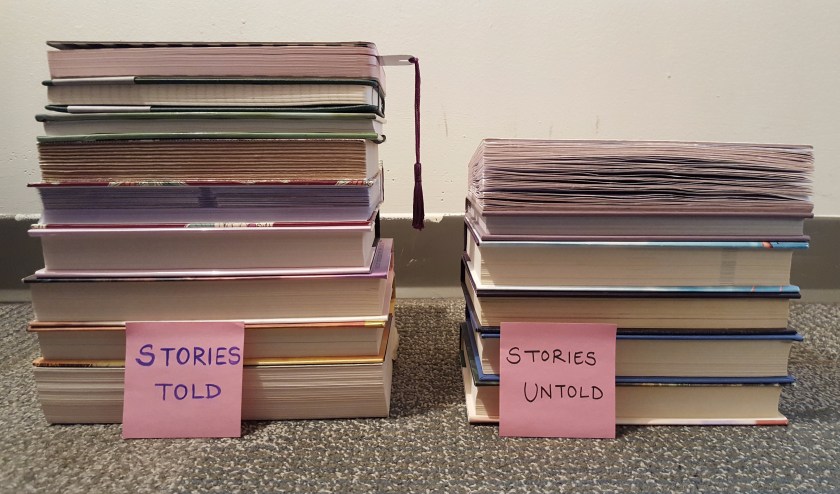
20171119_150008.jpg

We are all storytellers. We express ourselves through Instagram pictures, overly long Facebook posts, public blogs, or even just dramatic retellings at extra long lunch breaks with our friends. We love being narrators, in varying degrees of spotlight, and there’s something incredibly gratifying to have our audience connect with our narratives.

But ever so often, consciously or otherwise, we curate and edit our stories – and even if we call ourselves an open book, there are certain chapters we don’t read out loud, certain stories we don’t exchange while sitting around bonfires on beaches at night – because they don’t have conventionally acceptable happy endings, or because they paint us in an unflattering light, instead of as the valiant and righteous protagonists we’d like to be. So we bury these stories deep, never to see the light of day – and if we do decide to share them, we prefer to add filters to our photos, don masks for our one-man shows, and narrate our stories from a different angle. Maybe we’re afraid of being judged too harshly. Maybe the statute of limitations isn’t up yet. Maybe we are still in denial, and haven’t yet accepted this chapter. Maybe we look back and wonder what we were thinking in the first place, or if we were thinking at all. And so these stories, these untold stories, are kept under wraps because they spoil the overall narrative, you see? They don’t fit the image we’ve worked so hard to project. These stories are the chips in our armor, the unnecessary glimpses of flawed and painfully real humanity. It’s vulnerability laid out bare in front of the world, and we don’t want anyone to see it, because we ourselves struggle to reconcile with it. So we tell ourselves that it’s just a fluke, a one-off, and that the true narrative is still unblemished.

But don’t these stories deserve to be told? Aren’t these tales important? Don’t these chapters offer insights into self and values, knee-jerk reactions and instincts, as much as, if not more than the stories widely published? In fact, more than the stories themselves, the reasons why we choose to keep them under wraps is a deeply insightful, if difficult question, which provides a clear path towards exploring our own implicit biases and judgments. What do we feel, and why are we feeling this way? What guilt, shame, pain would we rather not deal with, and pretend doesn’t exist? While this ruminating may not change our public narrative dramatically, it does help the storyteller understand motives and reasoning of their primary protagonist – themselves.

We all love the image of ourselves we have in our heads – the perfect, flawless, whip-smart version of us who never messes up. Who never makes mistakes. Who knows exactly what to say at the right time. Who is kind and thoughtful, but also not a pushover. Who has no hair out of place, no wrinkles in their perfectly ironed clothes, no chinks in their armor. Who’s always more talented, more unstoppable, simply more than who we are in reality.

But you know what? That isn’t who you really are. You are not perfect – instead, you are real. You are real, and flawed, and just figuring out those flaws, and working on what you think warrants change makes you gloriously human. It’s hard, so very hard to remember that vulnerability is not weakness. Your messy emotions, your honest-to-goodness pain, your rawness, your awkwardness – may not be perfect, but they don’t have to be. You don’t have to be. All you have to be is your unique self, flaws and all. So let’s remove those filters. Let’s throw off those masks. Let’s read out those stories, loud and proud. Here’s to being fearless, instead of flawless!

In the driver’s seat

So you see, the honest answer to that is yes, I can. I CAN drive a car, you know, just as long as I’m barefoot, it’s a manual, someone is barking rapid-fire instructions at me, and I’m allowed to drive on the left side of the road.

I don’t drive. While I was growing up in Indore, I’d take my bicycle or my mom’s scooter to travel short distances, and Dad would drive me if I wanted to go beyond a certain radius. When I moved to Pune, I promptly adapted to elbowing my way into overcrowded buses and haggling over ‘meter’ charges with rickshaw-wallas. After moving to the States, I have been lucky enough to live in Manhattan which has a pretty great public transport system. Conveniently, parking is criminally expensive, so nobody expects me to have a car to drive anyway.

If anyone ever asks me if I can drive, I usually say no. That isn’t completely true, but the truthful answer requires a long-winded and rather ridiculous backstory.

I did learn to drive in India. During one of my winter breaks from college, I attended fifteen days of driving classes in Indore. I was taught by a female retired police officer, who was proportioned like Madame Maxime and behaved like Mad-Eye Moody. She was brisk and efficient, but wouldn’t let me rest my feet against the brake or accelerator unless I kicked off my shoes first. She assumed all women wear wedges and heels while driving, and claimed that that wouldn’t give me a real feel of just how much pressure I’d have to apply for the car to respond. So now every time I get into the driver’s seat, my first few moves are to pull my seat up close to the dashboard (otherwise I’m this short-legged child whose feet dangle and don’t touch the pedals), adjust the mirrors, and then kick off my shoes before putting on my seat belt.

Madame Maxime’s next tactic was to drive me right into the middle of the crowded, traffic rule-flouting city, and then plop me in the driver’s seat. Me, an utter novice, who wasn’t mentally prepared to drive before I’d learnt the exact name and function of every single thingamajig of the car. But nope, I had to learn by diving into the deep end – so middle of the city it was. The parts of the city where there isn’t unidirectional or bidirectional flow of traffic, but pretty much two-, three-, and four-wheelers driving in whichever direction they pleased, in bumper-to-bumper traffic, amidst the ear-splitting din of annoyingly-pitched truck horns. While this experience taught me how to change gears instantly, and swerve to avoid stray cows plodding along the street, potholes, idiotic cyclists, and dogs who streak past the front of my car at the last possible second – it’s still a rather limiting skill set. Sure, I am fairly confident I will never crash into anyone, I have relatively fast reflexes, and have learnt to expect everything short of a UFO landing on the road in front of me. But on the other hand, I freak out the moment I have to go above third gear, simply because I have never had to. I can be the safest driver on the planet, but am probably also the slowest. I’m quite unsettled by empty roads and highways – what, am I expected to drive really fast, and own the whole road? That’s too much open space. Where is all the traffic?!

The third thing I learnt in driving school was how to obey orders instantly and without question. If Madame Maxime said stop, I slammed on the brakes with all my might. If she said switch to second gear, I did it instantly, before comprehending why. If she said I have to lean on the horn and press for several deafening seconds, that is exactly what I would do. While all this worked well for us in those two weeks, I never learnt how to drive without instruction. So the first time I drove without her by my side, it was incredibly unnerving. All of a sudden, I was expected to make all these decisions on my own. When exactly do I switch to second gear? How much do I slow down on my turns? Nobody else was looking out to estimate the size of the pothole coming up, and deciding if my wheel track was significantly wider than the pothole diameter, so I could safely drive over it instead of swerving to avoid it. That’s a lot of pressure, I tell you! What if I decide wrong? What if I switch to third gear, without anticipating giant orange construction barrels which suddenly materialize in front of me, and I panic and have to downshift to first, accidentally stalling the car in the process? (This happened while I was trying to impress my dad with my new-found driving skills in his new car. He was not impressed.)

After finishing up driving school, I got my driver’s license. There was a written multiple choice test, which I aced, because if there’s one thing I can do well, it’s prepping for theoretical exams. There was no actual driving test, which is quite alarming now that I think about it. Is this how all Indian driving licenses are handed out? Because that might explain a lot.

I haven’t learnt how to drive in the States yet, and have no immediate plans to do so. I’ve gotten by quite nicely in the last four years, and the whole process of buying or renting a car, getting a teacher, learning to drive in Manhattan traffic, and relearning all my driving coordinates (the left side of the road is NOT the right side to drive in this country!) seems a lot more hassle than it’s worth. I might do it at some point, once I find a reason more convincing than having to answer – ‘wait, you can’t drive?!’

So you see, the honest answer to that is yes, I can. I CAN drive a car, you know, just as long as I’m barefoot, it’s a manual, someone is barking rapid-fire instructions at me, and I’m allowed to drive on the left side of the road. I can totally drive! 😛 But for mine and everyone else’s sake, I’d really rather not!

Of tooth troubles and darling daughters

When I was about seven, my baby teeth started falling out. I was exceptionally proud of this fact, because I was the first kid in my class to start losing my milk teeth and getting my permanent ones, Those were also the days when kids used to excitedly show off their new erasers, pencils, pencil boxes and assorted paraphernalia in school. I was quite keen to start a new trend by showing off my teeth – not just the resulting gap in my mouth, but the actual tooth in a box.

Love isn’t what you say, it’s what you do. My dad is not the most expressive person – he won’t be the parent who calls me every night so I can prattle on about all my doings, but he will be the person who asks my mom about those said doings on a daily basis without fail, and is always updated on all my activities, mundane or otherwise. My dad has more interesting ways of showing how much he cares.

When I was about seven, my baby teeth started falling out. I was exceptionally proud of this fact, because I was the first kid in my class to start losing my baby teeth and getting my permanent ones. Those were also the days when kids used to excitedly show off their new erasers, pencils, pencil boxes and assorted paraphernalia in school. I was quite keen to start a new trend by showing off my teeth – not just the resulting gap in my mouth, but the actual tooth in a box.  Anyway, my front lower tooth had been loose for about a week, and while I couldn’t wait for it to fall off, I was much too scared of potential pain and blood. I refused to physically yank it out, or tie it with a string to a door so it could be pulled out Tom Sawyer style (much to my regret – that does seem like a pretty cool technique). After a whole week of nursing my tooth so carefully that not a crumb of food could come close, one fine afternoon while I was rinsing out my mouth over the sink, the tooth finally detached and fell off. Except of course it got washed down the sink and swirled right out of sight before my horrified eyes.

Seven-year-old me stood frozen for a few seconds, then turned around and dashed over to my parents in a flood of tears. I don’t remember what all they said to console me, because clearly none of it was effective. I’m sure I was told that I had 19 other teeth that would fall out, ergo 19 more chances to show off to all my classmates and teachers (also, in retrospect, which teacher actually wants to see a tooth in a box?!). While I continued crying and hiccuping, my mother redoubled her efforts to console me, and my dad eventually walked away. This was not a surprising turn of events, even at that age, because my mom has always had a lot more patience with my more irrational moods and demands, while my dad is prone to offer a slew of logical solutions to my problem, or even worse, laugh – such a clever strategy; what a surprise that I didn’t immediately wipe my eyes and smile a watery smile of gratitude at being jolted back into rationality.

Anyway, after my mom had administered enough hugs and sympathy, the waterworks did relent a bit. This is when I became aware of distant bangs and clangs, and mom and I went to investigate. There was my dad, with his toolbox, taking apart the pipes under the sink into which my tooth has vanished. He calmly dismantled the whole thing, and I kid you not, he went in and retrieved my lost tooth. After the hullabaloo subsided, the tooth was washed quite thoroughly, put in a box and shown off at school – minus the backstory of its eventful journey. Quite a satisfactory ending!

At that time, this event did not strike me as anything out of the ordinary: I was upset, I wanted something, and so my dad got it for me. Of course he did. But now when I look back, I am shocked, grossed out, but mostly filled with awe. Because you see, that is what love is. It’s not just words, chocolates and flowers – it’s not just the cliches I read about in my stash of romance novels. This is the one true example of love that comes to mind – doing something icky and unnecessary, just to make your kid happy. It’s the kind of love I have always got from my dad: solid and reliable, the sort of love you can rely on unconditionally. It doesn’t matter that we don’t talk every day, it doesn’t matter that he isn’t my primary sounding board, it doesn’t matter that we don’t express our feelings to each other on a regular basis – because whenever I have actually needed anything, he’s always there for me,  he’s got my back and I know he always will. And that is what unconditional love is.

While my dad’s medium is actions rather than words, I choose the written word to express all my sentiments, both simple or convoluted, heartfelt or plain cheesy. I would much rather spell out my feelings – because mild embarrassment and potential non-reciprocation is something I can live with, and words unsaid I cannot. So while I know it, and he knows it, and anyone who knows us knows it, I still want to say it out loud and clear … and not on any special occasion, birthday or anniversary, I want to say it just because: I love you, Papa! My first hero, my forever hero.