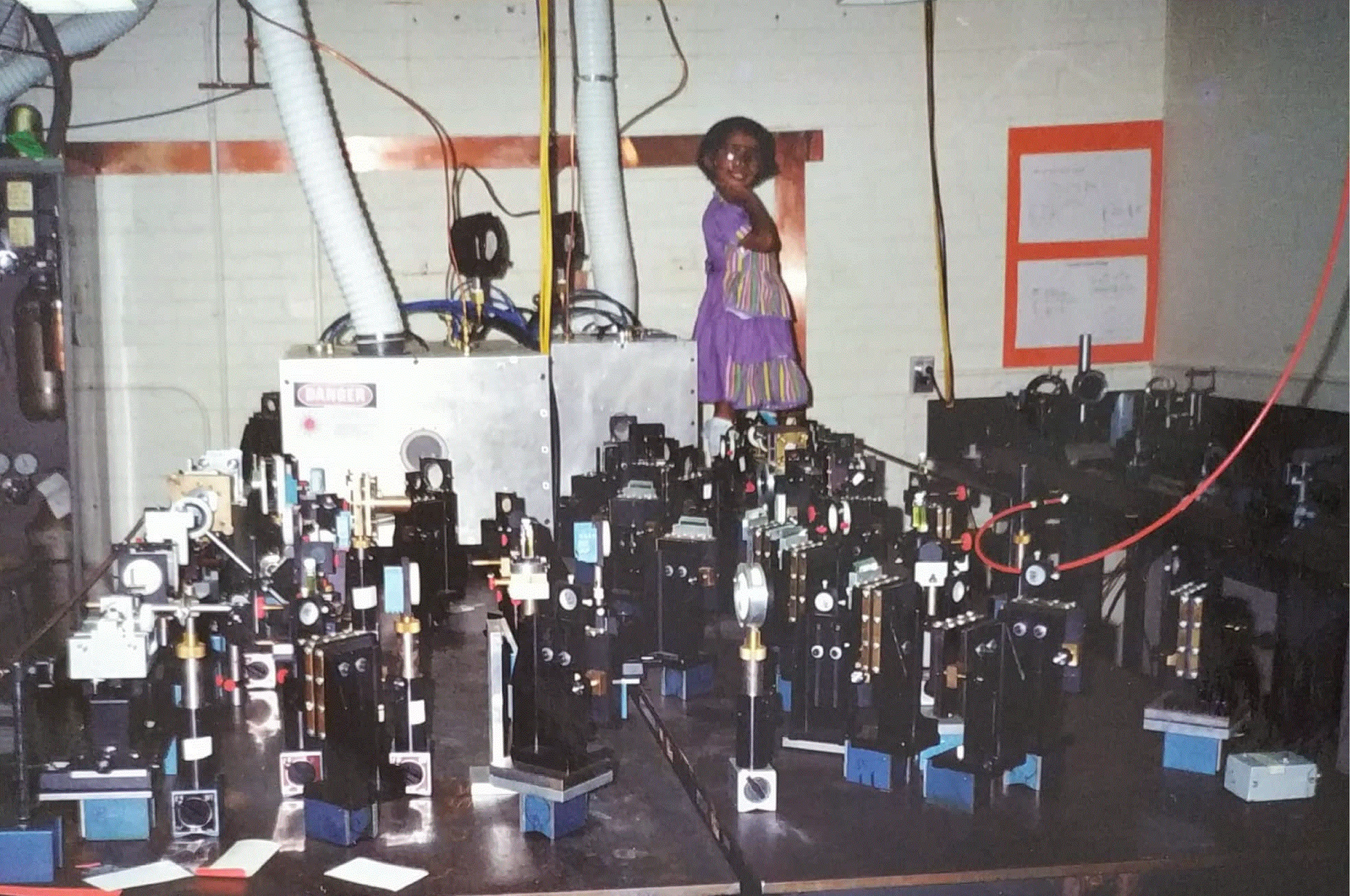
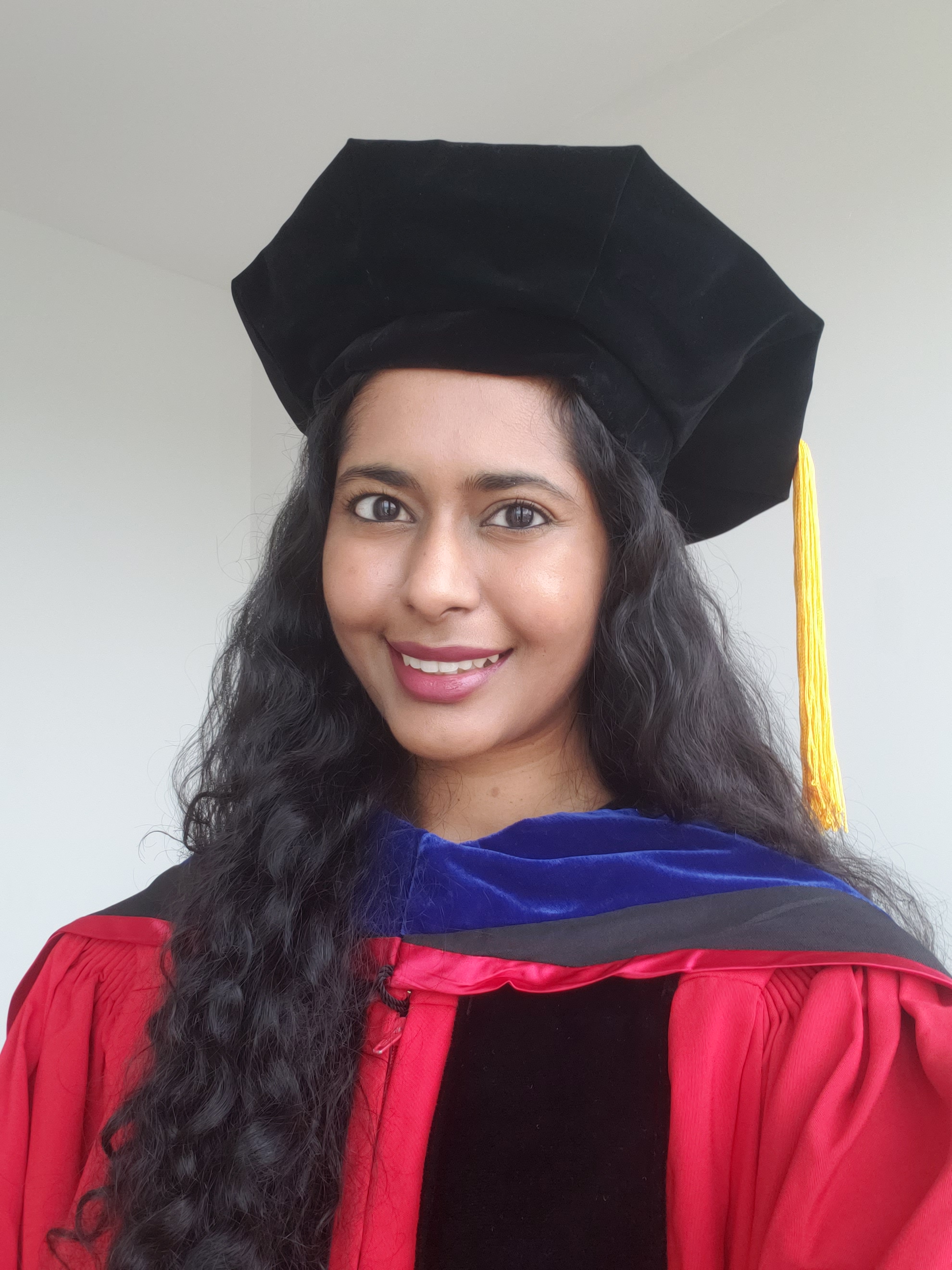
I attended my long-awaited PhD commencement a few months ago. It was a virtual ceremony of course, given the pandemic – but it was a proud and triumphant moment nevertheless. It was the fulfillment of a lifelong dream. Ever since I was 4 and walked into my dad’s super cool lab, I wanted to become a scientist, wear giant goggles, and add that “Dr” in front of my name.
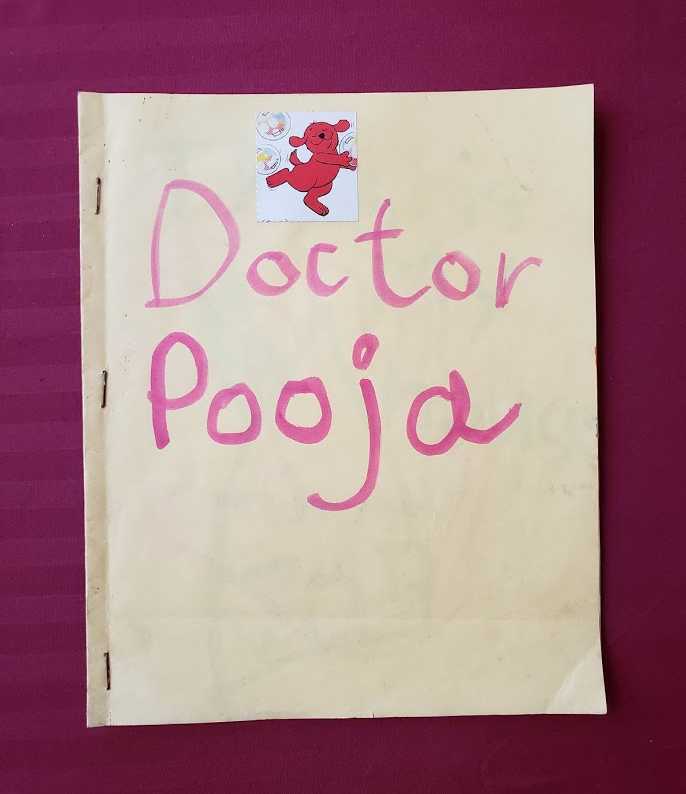
In fact, one of the very first books I ever wrote at the age of 5 was titled “Doctor Pooja”, complete with a Clifford the dog sticker. The contents don’t quite make for a compelling story, but it’s something I have always thought I would become. I never really questioned the dream, it was always the path I was going to follow.
The reason I did a STEM PhD is because I have spent my whole life truly believing in science. I grew up in a land where luck, superstition, and religion prevail, however I have considered myself above the fray – I will not blindly believe things I cannot see the evidence for. Why should I be wary of black cats who cross my path? Why shouldn’t I cut my nails on a Thursday or Saturday or whichever day is considered inauspicious? Why exactly do I need to eat white food before a big exam? I have never considered myself a particularly religious person, nor do I quite care for societal and cultural norms. I do not think they make sense in the current day and age – even if by some chance, they made sense in the day and age they came to be. I need a reason to believe in something, and it needs to be a convincing reason. I like questioning, I like analyzing, and any worship I did was at the altar of science. So yes, I proudly call myself a woman of science, a follower of logic, and in battles of the head vs heart, I like to think that my ultimate decisions are the ones that make sense. I have followed this path from my nerdy parents’ home in a scientific colony to a premier institute for science in India, all the way to a well-respected graduate program in New York City, where I finally earned my doctoral degree, confirming to myself and everyone else that I am indeed a scientist through and through.
And yet, one of the primary ways I got through my science PhD was by learning faith. Along with all the scientific techniques, the methodology, the endless assays, critical reasoning and analysis I learnt- in parallel to all that I had to pick up a good ol’ dose of faith along the way. Faith, which I had dismissed and scorned for the first 25 years of my life. Because like I said, I am the person who believes in concrete evidence, in irrefutable data. And all my life, I had enjoyed science. I did well in science at school. And the evidence for this was that I always scored well. My marks would not lie, would they? Neither would my teachers, my superiors, the people I looked up to. All the evidence pointed to the fact that I was and would be great at research. A science PhD was my calling, and I would barrel towards it.
Fast-forward to two years into my PhD: my driving force had collapsed upon itself. I was struggling to juggle multiple projects. I was floundering. None of my results were promising or convincing – they weren’t a definitive yes or no answer to my hypotheses, they were all a ‘try again later’. They were inconclusive and frustrating, and with each experiment that failed, I felt like I had failed. There was no evidence that my projects were working, and no evidence that I was suitable for grad school. In addition, I would routinely be told that all the failed experiments were because I wasn’t smart enough, focused enough, sincere enough. Every time I didn’t get the expected result, I was told that I must have done something wrong. I didn’t feel supported, I didn’t feel encouraged – instead, I was doubted, time and again, and I took it personally. I started doubting myself and my capabilities. I felt like I was flailing, thrashing about to stay afloat and yet still drowning. And the world, my world kept getting darker and darker. Every experiment, every lab meeting just made it worse. I couldn’t see a way through. It felt like I was all alone, struggling and failing, and instead of helping me up, the person who was supposed to help was kicking me while I was down. Meanwhile, everyone else around me appeared to be doing just fine. And so I stopped reaching out to people – family and friends and colleagues who could have helped – I didn’t want to let them see the full extent of the failure I felt, because, well, what if they agreed? What if they thought of me as a failure too? I couldn’t face that. And so I shrunk some more, curled up upon myself, hid my tears and panic attacks – and tried to hide away from the horrifying thought that maybe I was completely failing at the one thing, the only thing I had ever wanted to do. The only thing I wanted in life. This was my dream, this was it. There was no Plan B. And now, it looked like I wasn’t strong enough, smart enough, capable enough of achieving my dream. And that fear, that sheer terror of not being enough took over my life. It took over every thought, every action. I spent months, years, on the verge of tears. I burst into tears so often, that I quickly had to come up with a tried-and-tested three tier-system for places to cry in secret, based on the intensity of emotion, and how much time I could afford before I needed to suck it up and get back to work. My sleep patterns were completely wrecked – I lay awake at all hours of night just silently panicking about the results I still didn’t have, the experiments I needed to redesign. On the occasions I did manage to fall asleep, I would wake up with my heart thumping in my chest, feeling a crushing weight pinning me into my bed and I couldn’t sit up. I felt exhausted and broken down, and every single day, it was the same fight over and over. There was no light to be seen at the end of this tunnel.
I lost my driving force, you see. My belief system, in myself and my abilities had crumbled. My belief in academia had collapsed. I turned to gallows humor and escapism, joked about quarter-life crises, and spent every non-working moment immersed in fictional worlds. If I read fantasy novels non-stop till bedtime, if I binge-watched Friends over and over, perhaps it would turn off the part of my brain that was obsessing over my failures. For two whole years, I couldn’t fall asleep unless I had the TV on in the background. My head was not a safe space, my thoughts were not kind.
I had three options at this point – (1) quit my PhD, (2) switch to a different lab and hope things would be better, and (3) stick it through. I ruled out option 2 pretty quickly, because after a certain time, switching to a different lab would only restart my PhD timeline and add even more years to grad school. That was unacceptable. I thought of quitting – oh, how I thought of it. I was miserable and drowning and saw no way out. I was in my third, fourth, and then fifth year and was nowhere close to a solid project or a publication. I had no data to present at departmental retreats, no posters, no talks. As someone who was used to performing well, had defined herself by performing well, this was pretty unbearable. The only reason I didn’t quit was because I just couldn’t live with myself if I did that. I am not a quitter. I couldn’t live with myself if I quit my PhD, if I admitted that I couldn’t handle it and walked away. This would involve leaving the country. Leaving my dream. Starting over. Lost years. And so even if it killed me, I would not quit.
And so I stuck it out. I stayed. There wasn’t any one defining moment when I made this choice – I had to choose this option, time and again. It was a long painful process. I slowly started opening up to people about how I felt. I started realizing that I wasn’t alone, that there were people who felt like me. Smart people, talented people whom I looked up to, who were also struggling. The impostor syndrome was very real and isolating. I started letting people in to see my ‘failed’ vulnerable self. I opened up to my friends about it, let them see the messy reality of who I was at that moment. I asked for help. I grew less worried about how I would be perceived – frankly because after a point, keeping up a façade was more effort than it was worth. I relied on my family, I relied on my friends. No, the project did not change overnight. The constant stream of soul-crushing feedback I had to deal with didn’t change either. But I stopped hiding and tried to fight the shame. I swallowed my reservations and went to therapy. I reached out to people around me, to people in charge. I had to teach myself that ‘being sensitive’ was not a weakness. I am fond of logic and efficiency, yes, but I will never be an unemotional robot. I will always have feelings, big full-blown messy feelings – and that’s okay. I slowly learnt to accept all my emotions, to know that how I was feeling was not inherently wrong or right, it was just the way it was. I started advocating for myself, for my thought process and experiments, instead of immediately assuming I must have screwed up.
And somewhere along the way, I ended up building myself a new belief system. One that still enjoyed external validation, but did not require it. One where I actively worked on having faith in myself and my abilities, faith from within. And a little bit of faith in the universe. Faith that somehow things will eventually work out. And faith that while I can’t control everything, even if events and circumstances might be out of my control, I have the ability to handle it. That all I can do is control the factors I can, do the best with what information I have at any given moment, and then leave the rest to the universe. And believe that it will work out, one way or another, at some point in time. Perhaps in a way I couldn’t predict. I still wouldn’t call myself religious, but I did built up my own set of beliefs. Of blind faith, even when there’s no immediate evidence in front of me.
And slowly, things changed. I ended up finding a whole new angle to my project. It became a bigger and well-rounded story, and I could finally publish it. I could give talks, construct my own narrative around the data, and how I interpreted it. This was literally in my final months as a grad student, but I managed it. I convinced my committee to let me defend. And I enjoyed giving my defense talk. I realized over time that the process I truly enjoyed was not the day-to-day bench work, but creating narratives out of data, putting together the puzzle pieces to uncover the underlying picture. Surprise surprise! Storytelling has always been my thing. I just never thought I could make a career out of it.
So here I am, finally. Faith got me through my science PhD. It got me on a much different career path from what I had envisioned. It got me to a place where I get to indulge in my creativity, as well as think about science and data and how to help people. Faith got me to an unexpected place that has been a joy and revelation. It might someday lead me down other paths I haven’t planned on. But maybe I’m okay with not having my whole life planned out anymore. Maybe I don’t have to follow a trajectory I set in motion twenty five years ago. I know there are probably lots of surprises in store for me, of the pleasant and nasty variety – and there’s no way of knowing what will happen – but what I do know now is that I am capable, I am strong, and I will figure it out.
 Sunlit Prism
Congratulations on achieving your PhD! I am currently taking up my masters and believe me, I totally relate with the impostor syndrome. I have now extended my MS for a year because I couldn’t really work well during the pandemic. I wrote something about it on my blog, too. Faith is such an amazing and magical thing, indeed! I am a Math student and it’s all full of logic and reasons. It trained me to find out everything behind a thing. But faith, especially my faith in God, is something beyond understanding. It’s sometimes hard for us not to know, not to be weak, to be uncertain, but having faith comes a long way. Congratulations again.
LikeLiked by 1 person
Thank you so much for reading and commenting, Hanna! I’m sorry to hear that pandemic has caused you to extend your MS – but these are such uncertain times, and none of us know what’s going to happen next. Now is exactly the time to keep the faith and believe. I love your point about how faith is something beyond understanding, beyond all your mathematical reasoning. I am glad you have faith, and I hope it will make your journey a little easier! Good luck with everything – I’m looking forward to reading your blog as well. Thanks again 🙂
LikeLiked by 1 person
Congratulations Pooja, for obtaining a prestigious PhD! More congratulations for obtaining it on your own terms, finding your own narrative, for same Data. Even more congratulations for developing faith, in yourself and in universe that takes care of everything – ‘char & a-char’.
We understand it scientifically as ‘Rewiring of Brain’ and philosophically as ‘understanding the real connections’. So congratulations for all.
With many Ashirvads’
– Ravi Kaka & Sadhana Maushi
LikeLike
Thank you so much, Ravi kaka and Sadhana maushi! For those wonderful words, and also for your love and blessings 🙂 It means a lot!
LikeLike
Pooja
Your mom Arti and I always had and have faith in you that you would complete your Ph D successfully. Thanks for sharing your Lessons learned. Good to see childhood dream Dr Pooja became a reality. Proud of you. Congratulations.
LikeLike
Thank you so much for those wonderful words, Manju aunty 🙂 Your support and belief mean a lot!
LikeLike